
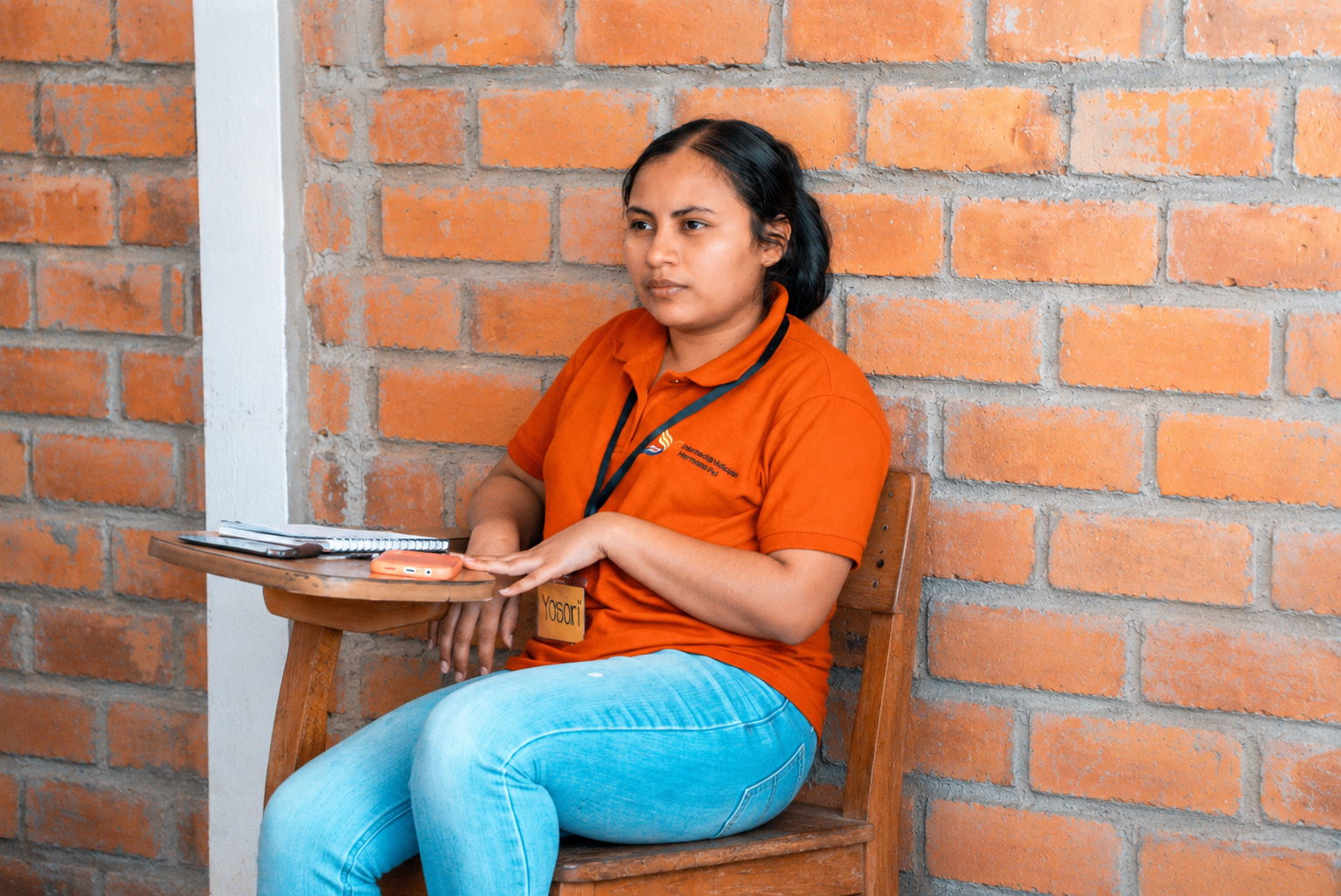
“I commit to be a shield of justice for those who cannot raise their voices.”
These are the words of Yosari Gámez, a student at Leadership Mission International, in her ethical leadership manifesto.
At the Leadership Center, students are not only preparing for careers, university, and community impact. They are also learning to ask deeper questions: What kind of leader do I want to become? What values will guide my decisions? How can I use my voice, not only for myself, but in service of others?
For Yosari, ethical leadership begins with a refusal to accept indifference.
Ethics helps students recognize injustice
In Central America, leadership matters deeply. Across the region, communities are shaped by complex challenges: economic inequality, migration, limited access to opportunity, corruption, violence, and the long-term effects of exclusion.
For many young people, especially young women from rural communities, leadership is not an abstract concept. It is personal. It determines whether families are heard, whether communities are served with integrity, and whether future generations can imagine a different path.
Recently, students at the Leadership Center were asked to write ethical leadership manifestos. The assignment invited them to reflect on the values that guide their leadership, the injustices they want to confront, and the kind of legacy they hope to leave.
Yosari chose to write about the fight against indifference and extreme inequality.
“My passion lies primarily in defending global equality and the rights of every human being,” she wrote.
Her manifesto names a reality many communities know well: injustice is not only caused by harmful actions. It is also sustained when people look away.
Ethics gives young women language for their values
In her manifesto, Yosari identifies love, integrity, empathy, responsibility, and courage as the values that guide her leadership.
She describes integrity as acting with honesty and transparency regardless of the people, place, or moment. She describes empathy as the ability to understand the feelings, opinions, and efforts of others. She describes courage as the will to do good even when everything seems to stand against the truth.
These are not abstract ideals. They are habits of character.
At LMI, ethical leadership helps students put language around the values they already carry and practice those values in community. Students learn that leadership is not only about confidence or achievement. It is about how they treat others, how they make decisions, and how they respond when something is wrong.
Ethics prepares students to use their voices for others
Yosari’s manifesto is not passive. It is a declaration of action.
She writes, “Believe every person is valuable enough to be treated equally.” She goes on to say that money, titles, surnames, or nationality do not define a person’s worth.
For students like Yosari, ethical leadership is a response to real experiences of injustice, exclusion, and broken trust. It helps them name what is wrong, clarify what they believe, and commit to leading differently.
This is especially important in rural communities, where young women are often underestimated or excluded from decision-making. When a young woman learns to speak with clarity and courage, it changes how she sees herself. It changes how she participates in her community. And over time, it can change what her community believes is possible.
Ethics matters because leadership without integrity can cause harm
Technical skills matter. English fluency matters. Job preparation matters. But skills without ethics can reproduce the same systems of exclusion that have harmed communities for generations.
LMI’s goal is not simply to help young women succeed individually. Our mission is to develop a new generation of ethical women leaders who use their hearts, minds, and voices to lead positive change throughout Honduras.
That kind of formation requires more than classroom instruction. It requires students to examine their values, practice accountability, listen to others, and understand that influence should be used to serve.
Yosari’s manifesto shows what this formation looks like in practice.
It looks like a student choosing honesty over convenience.
It looks like a student refusing to stay silent in the face of injustice.
It looks like a young woman learning that leadership is not reserved for people with power, money, or titles.
It belongs to those willing to serve.
Read Yosari’s full manifesto
Yosari closes her manifesto by describing the legacy she hopes to leave: a persistent fight against human indifference and for the equal rights of every human being.
Her words are bold, faith-filled, and deeply rooted in the belief that every person deserves dignity.
That is why ethical leadership matters.
Because when young women lead with integrity, compassion, accountability, and courage, they do more than imagine change.
They become the leaders who make it possible.