
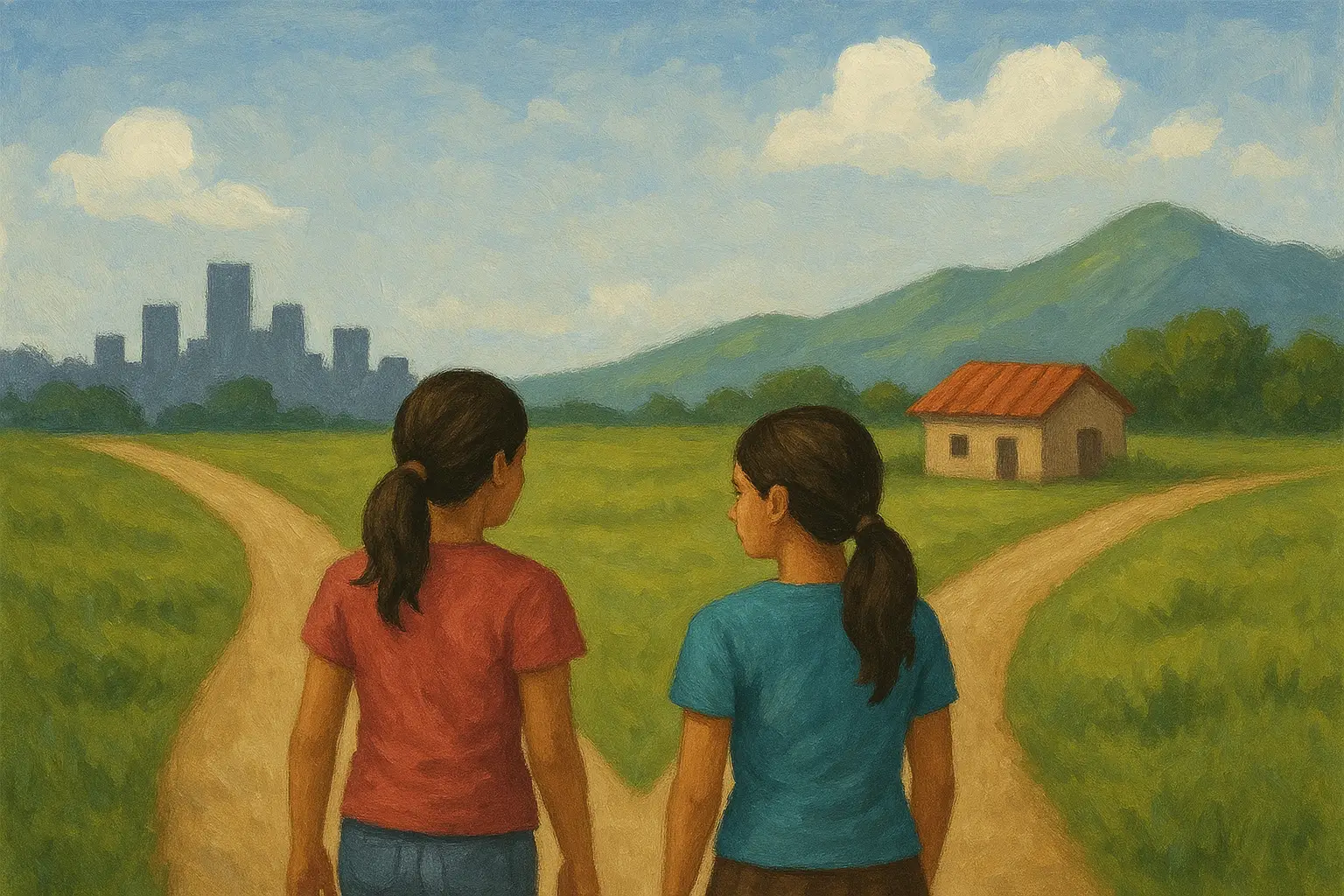
Ana and Rosa were born together in the rugged mountains of Intibucá, Honduras, identical twins whose lives began in the same small home where every lempira mattered. As the oldest of five children, they quickly learned responsibility, helping their mother tend to the younger siblings while their father labored long days in the fields. The family scraped by on barely $250 USD a month, often stretching meals and going without. At night, the sisters huddled around the kitchen table, bent over their schoolbooks under the weak glow of a single solar lamp. With no Wi-Fi and few resources, their imaginations became their window to the world, carrying them far beyond their village. By the time they finished high school, they faced a stark reality: the local options were scarce and limited to fieldwork or selling snacks on the roadside. Their dreams outgrew the narrow paths their community offered.
Though identical in appearance and upbringing, the twins’ lives would soon split down two very different roads. Both felt trapped by limited opportunities, but each chose a path that would shape not only her own future but the future of her family.
Rosa made the hardest decision of her life. With the help of a coyote, she crossed the border into the United States, enduring hunger, exhaustion, and fear. After weeks of uncertainty, she arrived in Florida, where she found work as a maid. The pay was more than her family had ever seen, but the cost was high: long hours, loneliness, and the constant shadow of deportation. Her younger brother, inspired by her path and desperate to help his family too, soon followed. He took the same dangerous route north, eventually finding work in construction. Their remittances became the family’s lifeline, sending money back each month to cover food, school fees, and medicine.
Ana’s path looked different. She applied to Leadership Mission International and was accepted. On the campus in Comayagua, she discovered a new kind of opportunity. At LMI she studied leadership, agriculture, and business. She learned how to grow crops resilient to climate change, how to manage small enterprises, and how to advocate for women in her community. Ana saw a future not in leaving her home, but in transforming it. Her dream became to create jobs in Honduras so fewer families would have to make the heartbreaking choice of migration.
The sisters’ lives reveal how two young women, born at the same time, in the same place, with the same family, can embody two drastically different outcomes. Rosa wakes at dawn in Florida, scrubbing floors and saving every dollar she can. Ana wakes at dawn in Honduras, walking out to the fields with other students, preparing to be the next generation of women leaders. Both sacrifice, both fight for their family. Their journeys show two diverging roads faced by countless Honduran youth—one of departure, one of transformation. Together, their story is not only a tale of two sisters, but a tale of Honduras itself.